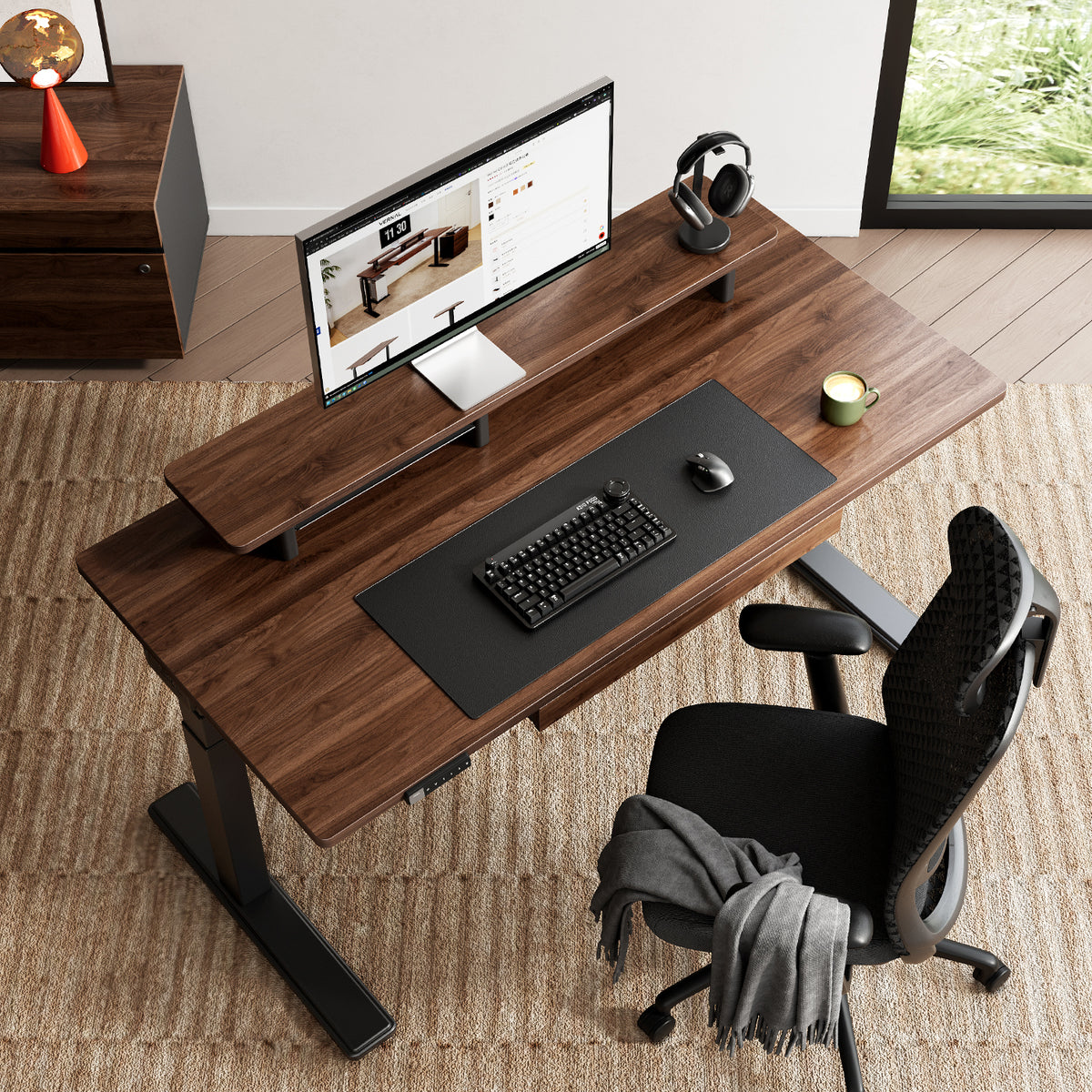
"I want my workspace to be a place that makes it easier. Without sacrificing any sort of personality."
Chris on designing a space that works harder, feels better, and actually feels like you
There is a strange moment that happens after finishing a workspace.
You finally get everything where you want it. The desk is clean. The cables are managed. The lighting looks right. Every piece of gear has its place.
For a while, it feels perfect.
Then, a week or two later, something starts to feel off.
Maybe a task takes a few more steps than it should. Maybe something is always in the way. Maybe the room has become cluttered again. Or maybe your interests have simply changed.
For Chris, this feeling is familiar.
As a photographer and creator who uses the same room for work, gaming, filming, 3D printing, repairs, and building things, Chris is constantly asking one question: how can one space work for all the different things he needs to do? And after years of changing, adding, removing, and occasionally regretting purchases, he has learned that a good workspace isn't really about getting everything right the first time.
It's about making space work better for the person using it.

A Workspace Has to Change With You
"When you see it come together it feels great," Chris says. "That soon fades, usually a week or two later."
The reason isn't necessarily that the original setup was bad. It's that real life quickly exposes things that look fine on paper.
A product might make a task more complicated. A piece of furniture might take up more space than expected. Clutter might make it harder to concentrate. Or a new hobby might suddenly require a completely different way of using the room.
For Chris, all of these things happen at once.
His interests are constantly changing, and he is always trying new things. Rather than seeing that as a problem, he wants his workspace to make those changes easier.
"I want my workspace to be a place that makes it easier. Without sacrificing any sort of personality."
That idea is important: a workspace doesn't have to stay the same to be successful.
It should be able to keep up with you.
Design Around What You Actually Do
Chris's room isn't just an office.
It's also a gaming space, filming studio, workshop, repair bench, 3D-printing area, and coffee station. That makes organization less about making everything look tidy and more about making different activities easy to start and finish. The challenge isn't fitting more into the room. It's making the room work for all of them without getting in the way.
For him, clutter isn't just something that looks messy.
It creates friction.
"I always find it hard to start a task or finish something if there is clutter about," he explains. "My mind will always be distracted."
That's why he tries to give everything a specific place and purpose.
The goal isn't to create an empty room. It's to create a room where you don't have to fight the room every time you want to do something.
That might mean keeping frequently used tools close to the workbench, hiding cables and chargers inside storage, or making sure a filming setup doesn't require half an hour of preparation before the camera can even turn on.
The physical environment becomes part of the workflow.
Chris's experience also reflects a broader idea in workplace research: having control over your physical environment can influence how satisfied you feel with that environment.
In other words, being able to shape your environment around the way you actually work can matter more than simply having a well-designed environment.


A Desk That Adapts to Different Ways of Working
Chris doesn't use his desk for just one type of work.
Some days involve editing and writing. Others involve gaming, filming, repairing gear, or simply moving equipment around the room.
That means one desk height isn't enough.
With different presets saved for sitting, standing, and gaming, switching between activities becomes effortless. For gaming in particular, Chris appreciates that the desk can go lower than many standing desks, giving him a more comfortable arm position during long sessions.
Mobility matters too. Adding casters allows him to move the desk easily for cable management, changing equipment, or adjusting the layout of the room without turning it into a major task.
Storage plays a similar role. Small tools, adapters, and everyday accessories stay hidden but within reach, reducing visual clutter without sacrificing convenience.
Rather than asking users to adapt to a fixed setup, the best workspace products adapt to the way people actually live and work.
For Chris, that's what makes a desk useful: not simply what it can do, but how naturally it fits into everyday life.

More Isn't Always Better
There is always another upgrade promising to make a setup better.
A new monitor. A more powerful dock. Smarter lighting. Another accessory designed to optimize a space.
Chris enjoys experimenting with new products, but years of changing his workspace have taught him that more capable doesn't always mean more useful.
His Thunderbolt 5 dock, for example, is technically impressive. It supports multiple high-resolution displays and includes features that many creators would appreciate. But Chris is also honest that, for his current workflow, it is probably overkill.
The same idea appears elsewhere in his workspace. He upgraded to a newer smart light with more features, only to realize he preferred the look of the older version. His photo printer isn't the most economical way to print pictures, but it gives him something he values more: immediate satisfaction.
Over time, Chris has become less interested in buying products simply because they are newer or more advanced.
"I like things that not only look good, but help me achieve what I set out to do."
It's a useful way to think about workspace design.
The question isn't necessarily, "Is this a good product?"
It's, "Does this make life easier in this particular space?"
A Workspace Should Tell You Something About Its Owner
Walk into Chris's workspace and you'll find plenty of technology.
But you'll also find a Leica camera, EVA books, Pikachu, Daruma, travel souvenirs, artwork, books, and other objects that have nothing to do with productivity. Not everything in a workspace needs to justify itself through productivity. Some things are there simply because they mean something to you.
That's intentional.
Chris believes a workspace should reflect the person who uses it.
"I've seen countless setups online where someone has spent an absolute fortune on the best tech and accessories that money can buy, but it lacks any sort of personality," he says.
For him, the objects around his workspace aren't just decoration.
They remind him of places he's been, things he enjoys, and interests that have become part of who he is.
"When I sit down in my space, I want to feel inspired."
Personalization can serve a practical purpose, too. Research on workplace personalization has linked the presence of personal objects with satisfaction with the physical work environment.
Other research has looked more directly at how office décor communicates identity: personal objects, photos, and other visible details can act as physical signals of who someone is and what matters to them.
So the things on Chris's shelves aren't necessarily the opposite of productivity.
They are part of what makes space feel like his.


Your Workspace Doesn't Need to Look Like Everyone Else's
There is no final version of Chris's workspace.
And that's probably the point.
His needs change. His interests change. New tools come along. Some upgrades work. Some don't. Areas get rearranged. Things get moved, hidden, replaced, or brought back.
It's to create a space that makes it easier to do the things you actually want to do.
For Chris, that means reducing friction where he can, giving different areas a clear purpose, being honest about which gear is actually useful, and leaving room for the things that make the space personal.
Chris's Four Principles for a Workspace That Works
After years of changing, rearranging, upgrading, and occasionally regretting purchases, Chris's approach comes down to four simple ideas:
Design around what you actually do.
A workspace should reflect real habits and routines, not an idealized setup.
Remove friction.
If a task repeatedly requires moving, clearing, unplugging, or reorganizing something, the space probably needs to change.
Choose what genuinely helps.
More features don't always create a better experience. The best products are the ones that make everyday tasks easier.
Leave room for personality.
Not everything in a workspace needs to be optimized. Some things are there simply because they inspire you or remind you of what matters.
"Do I want to be in a space that is the same as everyone else's on the internet, or do I want to make it mine and unique? I choose the latter."
Perhaps that's why there is no final version of Chris's workspace. And maybe that's exactly the point.

- Regular price
-
$899.99 $1,299.99 - Regular price
-
$0.00 - Sale price
-
$899.99 $1,299.99

- Regular price
-
$1,189.99 $1,629.99 - Regular price
-
- Sale price
-
$1,189.99 $1,629.99